SARS coronavirus discovery
The Wisdom of CrowdsThe SARS coronavirus discovery was the result of an international research effort that turned scattered reports of a new disease into an evidence-based identification of its cause. In early 2003, eleven laboratories coordinated by the World Health Organization investigated SARS in parallel, sharing samples and results rather than waiting for a central authority to direct every step. Their work identified a coronavirus as the cause within a month, illustrating how scientific knowledge can depend on collective investigation as well as the subsequent scrutiny and acceptance of a research community.
Outbreak and the search for a cause
In early February 2003, China’s Ministry of Health informed the World Health Organization that 305 people in Guangdong Province had suffered a severe respiratory illness since November 2002 and that five had died. The symptoms resembled influenza, but laboratory tests had not detected influenza viruses. Within weeks, a man returning from China and Hong Kong became ill in Hanoi, and workers at a Hong Kong hospital developed similar symptoms. Reports of further outbreaks followed. By early March, it was apparent that SARS was not simply a new kind of flu but a new disease.
The World Health Organization responded both to the spread of the illness and to the uncertainty about its cause. Because SARS was already known to pass from person to person, tracking cases and possible quarantine measures mattered. Identifying the pathogen was also essential: it could enable testing and potentially contribute to a vaccine. The organization issued a global warning for travelers to southern Asia and activated a surveillance system for new outbreaks while also organizing an international search for the disease’s source.
A distributed investigation
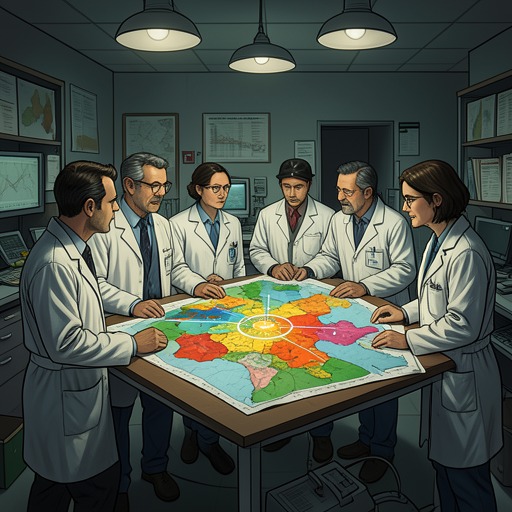
On March 15 and 16, the World Health Organization contacted eleven research laboratories in countries and regions around the world, including France, Germany, the Netherlands, Japan, the United States, Hong Kong, Singapore, Canada, the United Kingdom, and China. The laboratories agreed to collaborate and began the project on March 17. They held daily teleconferences to share work, consider possible lines of inquiry, and debate results. A World Health Organization website carried electron-microscope photographs of viruses isolated from patients, analyses, and test results; laboratories also exchanged virus samples so that they could check one another’s work and build on it.
The arrangement let separate laboratories investigate the same samples at the same time. In the opening days, researchers considered and ruled out several possible causes, including viruses found in some patients but not others. On March 21, scientists at Hong Kong University isolated a virus that appeared promising. Independently, researchers at the Centers for Disease Control in the United States isolated a virus that looked under the electron microscope like a coronavirus. That identification was not an obvious conclusion: coronaviruses were known to cause serious illness in animals, while their effects in humans were generally mild.
Over the following week, laboratories detected the coronavirus in a wide range of samples from people diagnosed with SARS. Researchers in Germany, the Netherlands, and Hong Kong began sequencing it. In early April, monkeys infected with the coronavirus in a Netherlands laboratory developed full-blown SARS. On April 16, only a month after the collaboration began, the laboratories were sufficiently confident to announce that the coronavirus caused the disease. The sequence matters: the initial identification supplied a candidate, while findings across samples, sequencing, and infection in monkeys strengthened the case that it was causal.
A discovery without a single discoverer
The work does not reduce to the achievement of one laboratory or researcher. Electron microscopist Cynthia Goldsmith, at the Centers for Disease Control and Prevention laboratory in Atlanta, first spotted the coronavirus. But that observation alone did not establish that the virus caused SARS. It took weeks of work across the network to test that proposition, while research that eliminated other candidates also narrowed the field. The account therefore attributes the discovery collectively to the laboratories: together they reached in weeks an answer that any one laboratory might have taken months or years to establish alone.
Nor was the network run as a conventional hierarchy. The World Health Organization brought the laboratories together, but no leader assigned each lab a virus or sample, dictated its investigations, or prescribed how results should move through the network. The participants agreed to share relevant data and speak every morning; beyond that, they worked out how to divide the investigation. The organization had no real authority to compel academic and government laboratories to comply, but that constraint did not prevent coordination. Each lab could pursue what it judged most promising and use its particular analytical strengths, while still drawing on the others’ results in real time. The account presents this self-organization as a practical strength, not merely an absence of command.
Evidence, trust, and scientific acceptance
The episode exemplifies a broader feature of science: it depends on information being made available for others to examine and use. Researchers generally publish important findings and share data rather than keeping them private. Other scientists can reconsider the evidence, challenge conclusions, or use the results to frame new hypotheses and experiments. Even work that rules out a candidate can help by showing colleagues where further inquiry is unnecessary. Scientific knowledge is therefore not only cumulative, resting on prior discoveries, but collective, sustained through exchange among contemporaries.
The discovery also distinguishes the existence of a fact from its acceptance as established scientific knowledge. The coronavirus caused SARS before the World Health Organization announced the finding. But the claim acquired standing as a scientific conclusion through the work of laboratories that scrutinized the evidence and reached agreement. Research groups around the world could then pursue possible tests and vaccines on the premise that SARS was caused by a coronavirus. In this sense, scientific recognition is not a vote that makes a biological fact true; it is a community process by which evidence becomes credible enough to enter shared practice and the common body of knowledge.
That process necessarily involves trust. Most scientists do not personally repeat most experiments on which their work depends; they rely on the reported data and on the expectation that other researchers have worked fairly. Experiments can be replicated, and fraud can be exposed, but constant repetition of every result would consume time that researchers could otherwise spend on new questions. The SARS collaboration makes the balance visible: laboratories shared evidence and checked one another’s work, while the broader community could use their findings without each researcher independently reproducing the entire investigation. Its speed and result depended on both distributed scrutiny and confidence in a common scientific enterprise.